
Roofing Materials • West Michigan
Slate Roofing: The Century Roof, Honestly Explained
Few materials say built to last like slate. With a lifespan measured in generations, it's the roof you install once and never think about again.
Here's an honest look at natural and synthetic slate for West Michigan homes: the lifespan, the weight and cost realities, where each makes sense, and how they stack up against asphalt and metal.
Is Slate Right for Your Roof?
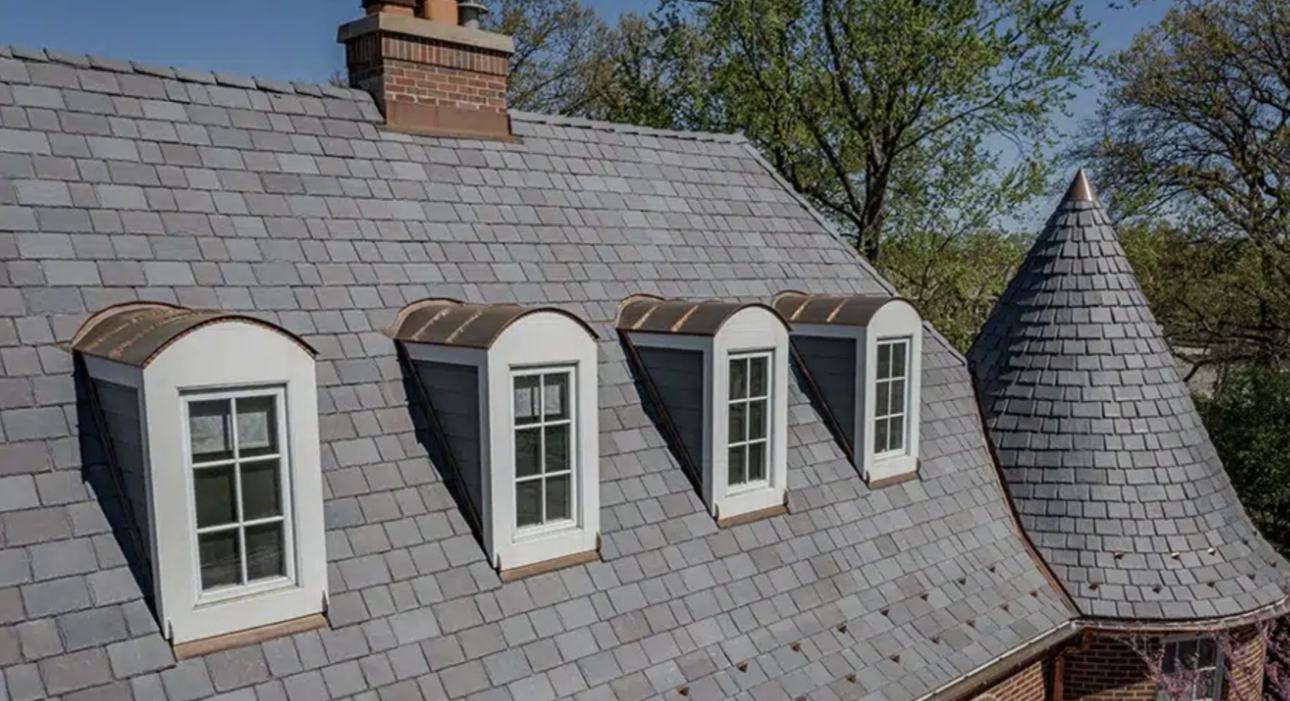
Slate is the longest-lasting roofing material you can put on a home. A properly installed natural slate roof protects a house for 75 to 100 years or more, and the best stone runs past a century, easily outliving the asphalt roof next door two or three times over. The trade-offs are just as permanent: genuine slate is quarried stone, it weighs 800 to 1,500 pounds per square, and it demands a specialized crew and hardware built to match its lifespan. It's also become a rare trade. Only a small fraction of roofers in the country are trained to install slate correctly, and around West Michigan, true slate roofs are the exception, not the rule.
That's why synthetic slate has become the practical path for most homeowners who love the look. Molded polymer and composite tiles capture the same deep, layered texture at a fraction of the weight and cost, carry a UL 2218 Class 4 impact rating, the highest hail rating there is, and install on standard framing. It's the same modern composite family we'll show you next to composite shake, and for the majority of homes chasing the slate aesthetic, it's the smarter total investment.
Our honest position: we'll give you the truth about both. If your home is one of the rare ones where natural slate genuinely belongs, a historic roofline, an estate build, a structure that can carry the stone, we'll tell you exactly what that takes and what it costs, and we'll tell you plainly whether your framing can even hold it. For everyone else, we'll put synthetic slate, standing seam, and designer asphalt side by side and let the roof decide. We're not here to sell you a roof you don't need.
Types of Slate Roofing
“Slate” covers a few very different products. Here are planning ranges and expected lifespans for the options West Michigan homeowners actually choose between.
Natural Slate
Market range $15 to $30 per sq ft installed
Lifespan: 75 to 100+ years
Quarried stone split into tiles, the genuine, timeless article. Unmatched longevity and a rich texture that ages beautifully, but very heavy, expensive, and demanding: the framing, the fasteners, the flashing, and the crew all have to be up to a century of service.
Synthetic Slate
Roughly $9 to $16 per sq ft, priced on inspection
Lifespan: 40 to 50 years
Engineered polymer and composite tiles molded from real slate. A fraction of the weight, Class 4 impact-rated, engineered for freeze-thaw, and installed on standard framing. The practical way to get the look, and the version we quote and install.
Fiber-Cement / Hybrid
Market range $8 to $14 per sq ft
Lifespan: 30 to 50 years
Cement-and-fiber composite tiles that mimic slate at lighter weight. A middle-ground product, but color stability and freeze-thaw performance vary more than the premium synthetics, which matters in our climate. We'll tell you straight if a specific product isn't built for a Michigan winter.
Ranges are planning estimates, not quotes. Natural slate on a home that needs framing reinforcement runs higher, and we confirm every number with an on-site inspection.
Slate vs. Synthetic vs. Asphalt vs. Metal
| Spec | Natural Slate | Synthetic Slate | Architectural Asphalt | Standing Seam Metal |
|---|---|---|---|---|
| Lifespan | 75 to 100+ yrs | 40 to 50 yrs | 20 to 30 yrs rated, 30 to 35 achievable done right | 40 to 70 yrs |
| Installed cost per sq ft | Market range $15 to $30 | Roughly $9 to $16 | $5 to $10+ | Starts around $12, can exceed $25 to $30 |
| Weight per square (100 sq ft) | 800 to 1,500 lb | 150 to 300 lb | 250 to 400 lb | 100 to 150 lb |
| Structural upgrade needed? | Often | Rarely | No | No |
| Impact and hail | Good, but tiles can crack | Class 4, the best rating | Class 4 options | Class 4 options |
| Freeze-thaw durability | Excellent | Very good | Excellent over a proper system | Excellent |
The weight row is the one that surprises homeowners most: natural slate weighs three to five times what asphalt does. That dead load is exactly why any natural slate conversation starts with your framing, not your color preference.
Weight, Hardware, and Cost: What to Know First
Natural slate's biggest strength, solid stone, is also its biggest complication. At 800 to 1,500 pounds per square, a full slate roof adds several tons of dead load, and many West Michigan houses framed for asphalt simply weren't built for it. Before anyone quotes you natural slate, the rafters, trusses, and decking need a real structural assessment, with a structural engineer involved when the load calls for it. That step is non-negotiable, and any roofer who skips it is telling you something.
The second thing nobody mentions: a century roof needs century hardware. Standard galvanized flashing fails in 25 years, which on a slate roof means pulling and resetting stone tiles, and risking breakage, three or four times over the roof's life. Done right, slate gets copper or stainless flashing and fasteners that last as long as the stone. That's part of why real slate costs what it costs, and it's the same principle we build every roof on: the system has to match the material, or the material's lifespan is a marketing number.
Synthetic slate sidesteps all of it. At 150 to 300 pounds per square it installs on standard framing with standard timelines, delivers the depth and shadow lines of the real thing, and takes hail that would crack stone. For most homeowners drawn to slate, it's the smarter total investment, and a premium roof spreads into monthly payments through our financing partners.
Slate Roofing Pros & Cons
The Advantages
- Longest lifespan of any roofing material, often outlives the homeowner
- Non-combustible and naturally fire-resistant
- Rich, dimensional look that suits historic and estate architecture
- Excellent through West Michigan freeze-thaw and lake-effect snow
- Natural slate is a fully mineral, low-maintenance surface
- Can raise resale value and curb appeal on the right home
The Trade-Offs
- High up-front cost, several times the price of asphalt
- Very heavy; most homes need a structural evaluation, and some need reinforcement
- Requires one of the few crews in the trade trained to install and flash it
- Individual tiles can crack under foot traffic or falling limbs
- Repairs and matching tiles demand slate-specific expertise for the life of the roof
- Longer install timeline than shingle or metal systems
Where Slate Makes the Most Sense
Historic and Heritage Homes
Older Heritage Hill, Eastown, and Holland-area homes originally designed for slate keep their authenticity, and often their historic-district compliance, when re-roofed in natural or synthetic slate.
Estate and Custom Builds
On larger Ada, Forest Hills, and Cascade custom homes, slate delivers a distinctive, permanent roofline that matches stone and high-end brick exteriors.
Steep, Prominent Rooflines
Slate reads best on steeper pitches where its texture and shadow lines are visible from the street, exactly the roofs that show the material off.
Weight-Conscious Retrofits
When a homeowner loves the slate look but the framing can't carry natural stone, synthetic slate delivers the aesthetic without a structural project bolted onto a roofing project.
A Slate Roof Is Worth Considering When
Slate is a long-horizon decision. It rewards homeowners who plan to stay, who value permanence, and whose home suits the look.
Not sure slate is the right fit? We'll walk your roof, assess the framing, and lay out synthetic slate, metal, and asphalt side by side, with the honest answer on natural stone. Schedule your free roof inspection or call or text (616) 840-1927.
Compare Roofing Materials & Options
Slate Roofing Questions
How long does a slate roof last in Michigan?
A properly installed natural slate roof commonly lasts 75 to 100 years or more, with the best stone running past a century, and it handles West Michigan freeze-thaw and lake-effect snow exceptionally well because stone doesn't degrade from UV or moisture the way asphalt does. Synthetic slate typically lasts 40 to 50 years. Either way, the installation decides whether you get those numbers: the wrong fasteners, headlap, or flashing can cut a slate roof's effective lifespan in half.
What's the difference between natural and synthetic slate?
Natural slate is quarried stone: the genuine, longest-lasting product, but 800 to 1,500 pounds per square, expensive, and dependent on a specialized crew and copper-grade hardware. Synthetic slate is molded polymer composite that mimics the look at roughly a fifth of the weight and a fraction of the cost, carries a Class 4 impact rating, and installs on standard framing. For most homeowners, synthetic delivers the slate aesthetic without turning a roofing project into a structural one.
Does my house need to be reinforced for a slate roof?
For natural slate, often yes. Genuine slate weighs three to five times what asphalt does, so the rafters, trusses, and decking need a structural evaluation before anyone quotes stone, with an engineer involved when the load calls for it, and homes framed for asphalt frequently need reinforcement. Synthetic slate weighs 150 to 300 pounds per square and installs on standard framing, which is one of the main reasons homeowners choose it.
How much does a slate roof cost in West Michigan?
Natural slate runs a market range of roughly $15 to $30 per square foot installed, before any structural work, making it one of the most expensive residential roofs there is, and the specialized labor is half the cost. Synthetic slate runs roughly $9 to $16 per square foot and is priced on inspection. Final numbers depend on size, pitch, complexity, and framing, and whole-house figures mean nothing until the roof is measured.
Is synthetic slate as good as the real thing?
Different strengths. Natural slate wins on raw lifespan and authenticity; nothing else is stone. Synthetic wins nearly everything else that matters here: it takes 2-inch hail with a Class 4 rating where stone tiles can crack, it's engineered for freeze-thaw, it needs no structural upgrade, and it costs a fraction to buy and repair. From the street, quality synthetic reads as slate. Ask to see samples of both next to each other before you decide; most people are surprised.
Do you install slate roofs?
Here's the honest answer most companies won't give you. Synthetic slate, yes: we quote it, install it, and put it side by side with composite shake, standing seam, and designer asphalt so you can compare. Natural stone slate is a rare, specialized trade, and if your home genuinely calls for it, we'll assess the structure, tell you exactly what a real slate roof requires, and point you honestly at what it takes, including whether we're the right fit for that specific project. What we won't do is pretend a crew is slate-trained when it isn't. That's how century roofs fail in a decade.