
Roofing Materials • West Michigan
Asphalt Shingle Roofing in West Michigan
Asphalt shingles cover roughly four out of five homes across Grand Rapids, Holland, Ada, and the lakeshore, and for good reason. They balance cost, durability, and looks better than any other roofing material.
Here's a clear, no-hype guide to the shingle grades we install, their pros and cons, how long they really last in Michigan weather, and what you'll actually pay.
Why Asphalt Is West Michigan's #1 Roof
Walk any neighborhood from Rockford to Byron Center and count the roofs. The vast majority are asphalt shingle. It's the most popular roofing material in America, and it dominates West Michigan for three simple reasons: it costs less, installs fast, and handles our climate well.
A complete asphalt roof runs a fraction of the price of metal or premium systems, yet a quality architectural shingle still delivers decades of protection against lake-effect snow, freeze-thaw cycles, and the wind off Lake Michigan. Add hundreds of color and profile options and simple, affordable repairs, and it's easy to see why asphalt is the default choice.
Two things worth knowing up front. First, not all asphalt shingles are equal: the difference between a standard architectural shingle and a designer shingle is real, in lifespan, wind resistance, and curb appeal. Second, the shingle is only about 40 percent of the roof. The other 60, the deck, ice and water shield, underlayment, flashing, and ventilation, decides whether any shingle reaches its rating.
Architectural vs. Designer Shingles
Architectural Shingles
$5 to $10+ per square foot installed as a full system
Lifespan: rated 20 to 30 years
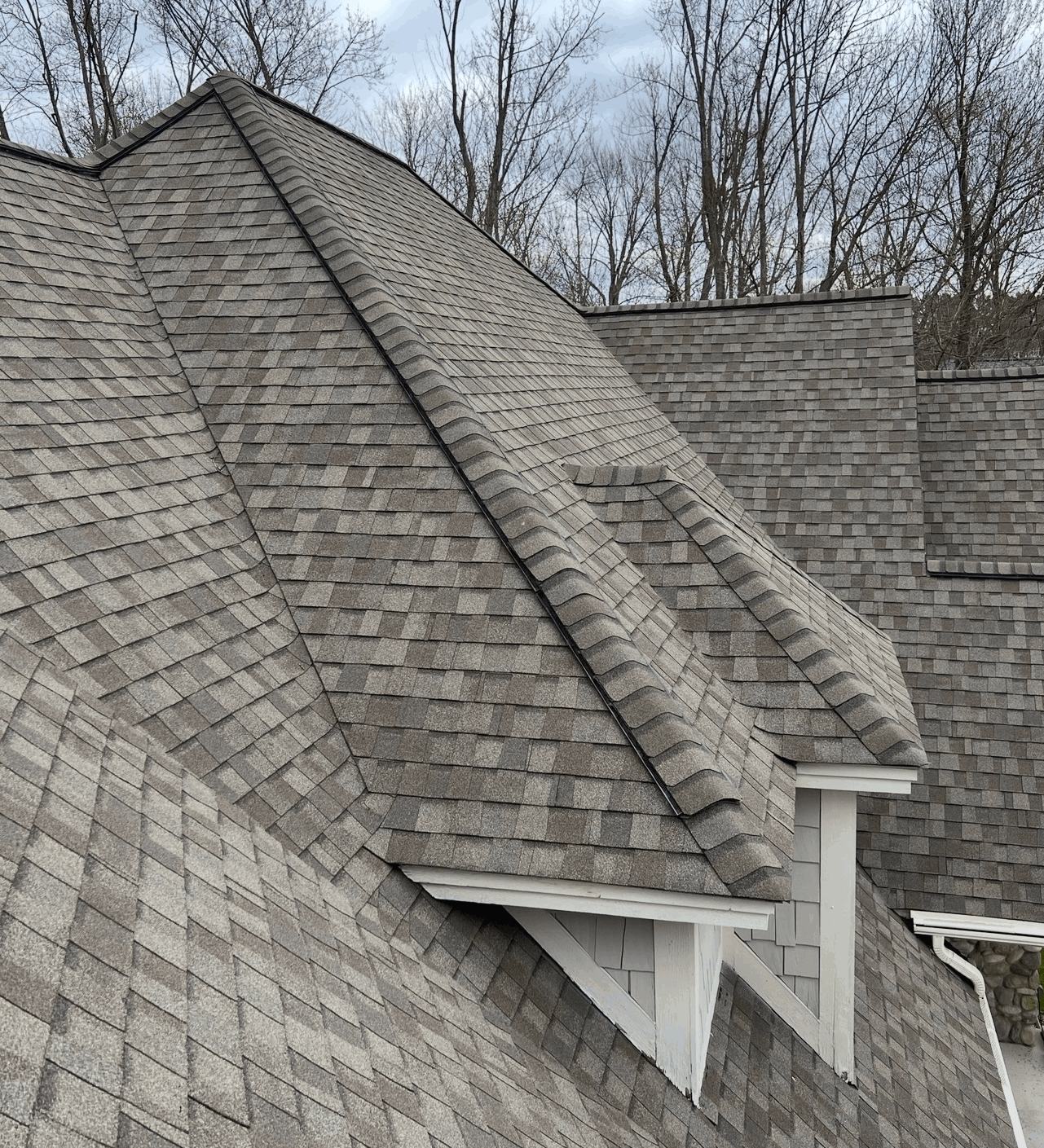
Also called dimensional or laminate shingles, these bond two layers for a thicker, shadowed, wood-shake look. Rated ASTM D3161 Class F (110 mph) or ASTM D7158 Class H (150 mph) for wind, with Class 4 impact-rated options, they're the default on nearly every Grand Rapids re-roof we do.
Designer / Luxury Shingles
Priced on inspection, typically at the top of the asphalt range and above
Lifespan: rated 30 to 50 years
Heavyweight, multi-layer shingles engineered to mimic slate or cedar shake. The richest curb appeal in the asphalt family, with the highest impact and wind ratings. Popular on Ada and Forest Hills custom homes that want a high-end look without premium-system pricing.
Installed ranges reflect a complete system: tear-off, ice and water shield, underlayment, all new flashing, and disposal. See our roof replacement cost page for full-project numbers.
Shingle Comparison At A Glance
| Feature | Architectural | Designer |
|---|---|---|
| Relative Cost | Mid | Highest |
| Rated Lifespan | 20 to 30 yrs | 30 to 50 yrs |
| Wind Rating | Class F to Class H | Class H |
| Appearance | Dimensional, shadowed | Slate or shake look |
| Weight | Medium | Heavy |
| Best For | Most West Michigan homes | High-end custom homes |
For most homes, we recommend architectural shingles: the sweet spot of cost, lifespan, and wind resistance for our climate. Ready to re-roof? See our asphalt shingle replacement service.
Asphalt Shingle Pros & Cons
The Pros
- Lowest up-front cost of any full roofing system
- Fast installation, most homes finish in one to three days
- Huge range of colors and profiles to match any home
- Proven performance through Michigan freeze-thaw cycles
- Simple, affordable to repair one section at a time
- Strong manufacturer warranties, enhanced tiers available through certified installers
The Cons
- Shorter lifespan than metal
- Granule loss accelerates with age and heavy hail
- Susceptible to moss and algae streaking on shaded north slopes
- Petroleum-based, less recyclable than metal
- Absorbs heat, so attic ventilation matters for longevity
How Long Asphalt Lasts Here
Manufacturer lifespans assume ideal conditions, and West Michigan is not ideal. Lake-effect snow, ice dams, and dozens of freeze-thaw cycles each winter age a roof faster than the sunny climates those ratings are based on. But here's the part the ratings never tell you: the number on the wrapper is only half the conversation. Manufacturers spend tens of millions of dollars, combined it's hundreds of millions, marketing shingles, and a lot of roofing companies are effectively salesmen for the manufacturer.
Done right from the beginning, the roof you put on could be one of the last you ever put on, or at least the last one that house needs. Done wrong, it won't be. Every year we replace roofs that were installed within the last five to ten years, sometimes because the homeowner figured a roof is just a roof, sometimes because a previous owner wanted the cheapest possible roof so the listing could say “new roof.” There's that much gray area in this trade, and it's invisible from the driveway.
What actually decides the years you get? Three different things, and they fail three different ways.
- Ventilation decides how fast the shingle itself ages. An attic that can't breathe cooks the shingles from below in summer and drives ice dams in winter, and it's the single most documented cause of premature shingle failure. It can take years off the roof, and inadequate ventilation can void the manufacturer's warranty on top of it.
- Ice and water shield and underlayment decide what happens when water gets where it shouldn't. They don't age the shingle; they're the backup barrier under it. Skip them, or run the ice barrier only to the bare code minimum instead of past where the dam actually forms, and the first bad ice dam is in your ceiling instead of stopped at the deck.
- Flashing decides whether the walls, chimneys, and valleys leak. The metal itself lasts nearly forever, which is exactly why cheap roofs reuse it. But reused flashing almost never lines up correctly with the new shingle courses, and the sealant that was supposed to be reapplied never is. It almost guarantees a leak, and it's a massive liability the homeowner doesn't find out about until the water's inside. We repair roofs every single week where the flashing was reused, and a lot of those roofs are less than five years old. The shingle field is fine. The walls and chimneys leak. Stellar installs new flashing on every roof, every job, no exceptions. If a bid on your kitchen table is dramatically cheaper, reused flashing is one of the first places to look.
On the right house, under the right circumstances, with the right shingle and all three of those done right, we're confident we can design and install an architectural roof that realistically delivers 30 to 35 years before it absolutely needs replacement, possibly more. Designer shingles can go further still. The shingle is 40 percent of the roof. We build the other 60 like it's the part that matters, because it is.
Is Asphalt Right For Your Home?
If you want a roof that lasts decades longer, metal is worth a look. But for most homeowners weighing cost against performance, a quality architectural asphalt roof is hard to beat. We'll walk your roof, check the deck and attic, and give you the honest recommendation for your home.
What Does an Asphalt Roof Cost in West Michigan?
We price by the square: architectural asphalt runs $500 to $1,000-plus per square as a complete system, about $5 to $10-plus per square foot. In practice a simple ranch lands roughly $12,000 to $16,000 and a steep, complex two-story $18,000 to $26,000, and the only firm number comes after we've measured your roof. Financing is available through multiple lenders.
Explore Shingle Roofing & Costs
Asphalt Shingle Replacement
Our full tear-off and re-roof service for shingle roofs.
Learn MoreRoof Replacement Cost
Real 2026 price ranges for a West Michigan re-roof.
Learn MoreRoof Repair
Targeted fixes for leaks, lifted, or missing shingles.
Learn MoreRoof Financing
Spread your new roof into affordable monthly payments.
Learn MoreAsphalt Shingle Questions
How long do asphalt shingles last in West Michigan?
It depends on the grade and, just as much, on the system under it. Architectural shingles are rated 20 to 30 years and designer shingles 30 to 50, and on the right house, designed and installed right, an architectural roof can realistically deliver 30 to 35 years or more. The biggest factor in the shingle's own aging is attic ventilation; an attic that can't breathe cooks the roof from below and can void the manufacturer's warranty. Beyond that, ice and water shield protects you when water backs up, and new flashing at every wall and chimney, never reused, is what keeps the roof from leaking while the shingles still look fine.
How much does an asphalt shingle roof cost?
Architectural asphalt runs $500 to $1,000-plus per square as a complete system, about $5 to $10-plus per square foot installed, including tear-off, ice and water shield, underlayment, all new flashing, and disposal. Designer shingles price above that and are quoted after inspection. A simple ranch might land $12,000 to $16,000 and a steep, cut-up two-story $18,000 to $26,000. We confirm your exact number with a free on-site measurement, because whole-house figures mean nothing until the roof is measured.
Are asphalt shingles good for Michigan winters?
Yes, when installed correctly. Quality architectural shingles handle lake-effect snow loads and the high winds off Lake Michigan, and paired with ice and water shield at the eaves and valleys they resist the ice dams common in our climate. Attic ventilation is essential: it keeps the roof deck cold and even, which prevents the melt-and-refreeze cycle that damages shingles and feeds ice dams.
Why are asphalt shingles the most popular roofing material?
Asphalt covers about four out of five roofs in West Michigan because it costs far less than metal or premium systems, installs in one to three days, comes in hundreds of colors and profiles, and is simple to repair one section at a time. A quality architectural shingle over a properly built system delivers decades of protection, making it the best value for most homeowners.
Can I put new shingles over my old roof?
Michigan Residential Code Section R908.3.1.1 caps a roof at two layers, so a layover is only even possible on a single-layer roof, and we push people away from them anyway. A shingleover still costs about 75 percent of a full replacement, we can offer no warranty on one, it lasts maybe 50 to 75 percent as long, and over modern architectural shingles it's nearly impossible to do correctly. A full tear-off lets us fix the deck, install fresh ice and water shield, and give you the full warranty. More on our replacement FAQ.
What's the difference between architectural and designer shingles?
Architectural shingles bond two layers for a dimensional, shadowed look and carry the wind and impact ratings most homes need; they're the right call on the vast majority of West Michigan roofs. Designer shingles are heavier, multi-layer products built to mimic slate or shake, with the highest ratings in the asphalt family and a price to match. The honest question isn't which shingle is better; it's whether your house, your neighborhood, and how long you're staying justify the premium. We'll tell you straight during your inspection.