
Roof Problems in West Michigan
Roof Flashing Problems: Why Roofs Leak at Chimneys, Vents & Skylights
Most roof leaks happen where the roof meets something else. A chimney. A wall. A pipe. A skylight. A valley. Every one of those transitions is sealed by flashing, and flashing is where roofs live or die.
But let's be plain about something first: a roof can leak anywhere. It can leak in the middle of the field because a nail was driven a half inch too close to a seam and rusted through over ten years. Because a shingle got cracked on the top edge when the bundles were forked onto the roof, and nobody saw it. Because one installer, on hour nine of a hot day, seated one shingle out of the two thousand he laid that day a little bit wrong. Each shingle takes five to ten seconds to install. Tens of thousands of nails per roof. It doesn't take much.
And here's the part homeowners don't expect: that mistake might not show up for years, even decades. Most leaks need volume before you see them. A slow leak gets absorbed by the deck, the insulation, and the drywall long before it drips on a ceiling. Sometimes it's running out into the overhang or down a wall cavity, and you never see it at all until the wood is gone.
That's why the people who fix leaks for a living aren't the ones who install shingles fastest. They're the ones who understand how water moves through a roof, and how every piece of it, especially the flashing, is supposed to stop it.
What Is Roof Flashing?
Flashing is thin, formed metal, usually aluminum, galvanized steel, or copper, installed at every point where the roof is interrupted or changes direction. Its job is to bridge the gap between the shingles and a chimney, wall, vent pipe, skylight, or valley so water is carried over the seam instead of into it.
Shingles can't seal those transitions on their own. Flashing works by layering and overlap. Each piece tucks under the one above and over the one below, so gravity carries water down and off the roof and never gives it a path in. Done right, it's the most reliable waterproofing on the whole roof. Done wrong, rushed, reused, or replaced with a smear of sealant, it becomes the most common source of leaks in West Michigan homes.
Why Flashing Is Different From Everything Else on Your Roof
Here's something almost nobody outside the trade knows. Shingles come with an installation manual. Underlayment comes with a spec sheet. Flashing doesn't. No manufacturer publishes a real book on how to flash a chimney, a sidewall, or a skylight in a way that actually holds up through twenty Michigan winters. There are guidelines. There is no bible.
So flashing gets passed down. From the person who figured out what works to the person standing next to them on the roof. If nobody on the crew was ever taught it right, it gets done wrong, and it gets done wrong the same way on every roof that crew touches. That's why you see the same failures over and over across West Michigan: reused step flashing, no kick-out at the bottom of a wall, counter flashing surface-mounted and caulked instead of cut into the masonry, sealant doing the job metal was supposed to do.
We've been at the front of this since the day we started. For years we were the company builders and other roofers called in when the leak wouldn't stop and nobody could figure out why. Chimneys that had been re-caulked five times. Valleys that leaked through three roofers. That's where you learn what actually works. You get exposed to building science, to physics, to how water and heat and cold move through a structure, to how the metal, the membrane, and the sealant behave against each other over years. You learn that the flashing detail is only as good as every bend, every hem, every overlap, and even the chemical makeup of the sealant you pick to go with it. Get one of those wrong and the whole detail fails.
That's not something you learn from a YouTube video, a manual, or a manufacturer rep. It's artisanship, and it's learned from artisans. Our tradesmen were trained by people who'd already torn apart thousands of failed roofs, and now they're the ones doing the training. On a roof, this is one of the biggest things that sets us apart. It's also why other roofing companies still call us.
Where Flashing Fails, and Why
Flashing lives at the busiest, most exposed points on the roof. Here's where it breaks down in our climate.
Chimneys
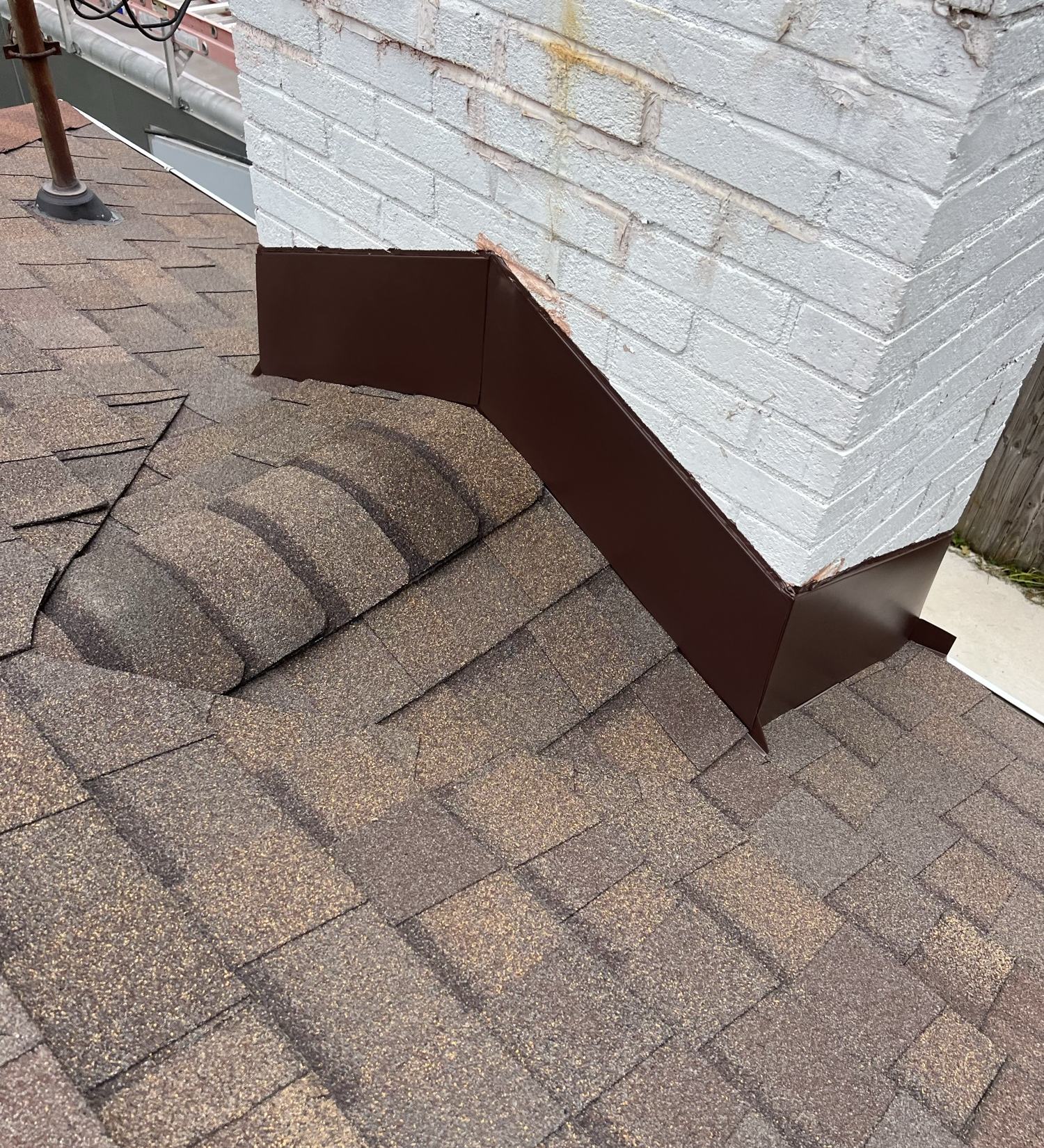
A chimney needs two layers: step flashing woven into the shingle courses and counter flashing set into the masonry. Freeze-thaw cracks the mortar joints, the counter flashing pulls loose, and water runs down the chimney chase into the attic. Reused step flashing and surface-mounted, caulked counter flashing are the two mistakes we fix most.
Plumbing and Exhaust Vents
The rubber pipe boots around plumbing stacks and bath fans are the shortest-lived part of most roofs. UV and cold split the collar in 10 to 15 years, and the pipe itself moves with the house and works the boot loose. Leaks here usually show up as a stain on a bedroom or hallway ceiling.
Skylights
Skylights have their own flashing kit: head, sill, and step pieces. If it was installed wrong, sealed with caulk instead of metal, or the gaskets have aged, rain and condensation track along the frame and drip inside. Most homeowners assume the skylight is "sweating." It's leaking.
Valleys
Two roof planes meeting means a huge volume of water and snowmelt. Debris, rust, shingles cut too tight, or no kick-out at the bottom of the valley lets water get under the metal. Common on the steep, complex roofs across Ada and Forest Hills.
Walls and Dormers
Where the roof meets a vertical wall, step flashing has to tuck behind the siding, and there has to be kick-out flashing at the bottom to throw water back onto the roof. Reroofs that reuse old flashing, or siding installed over the top of it, build a hidden channel for water into the wall.
Drip Edge and Eaves
Missing or bent drip edge lets water wick back onto the fascia and sheathing. Add an ice dam and this is the leading cause of the rotted eave and soffit damage we see on older West Michigan homes every spring.
Notice the pattern. Almost every one is tied to freeze-thaw, lake-effect snow, the ice dams they create, and a house that never stops moving. Flashing that would last decades in a mild climate is under constant stress here.
Signs Your Flashing Is Failing
Flashing leaks are sneaky. The water often travels along a rafter or a pipe before it drips somewhere far from the actual gap. Watch for:
- Water stains on ceilings or walls near a chimney, skylight, or vent
- Rusted, lifted, or visibly separated metal around roof penetrations
- Cracked or crumbling caulk and tar "repairs" at flashing joints
- A split or hardened rubber collar on a plumbing vent boot
- Peeling paint or damp drywall on an interior chimney chase
- Daylight or moisture visible around penetrations from inside the attic
- Loose or missing mortar where counter flashing meets the chimney
- Musty smell or mold in the attic after heavy rain or snowmelt
If you spot even one, it's worth a look before the next big rain or thaw. Catching it early is the difference between a reflash and a torn-out ceiling.
Why a Small Flashing Gap Becomes a Big Problem
A failing piece of flashing is cheap to fix and expensive to ignore.
It Rots the Deck and Framing
Flashing leaks are slow and hidden. By the time a ceiling stain appears, water has often been soaking the deck, rafters, and insulation for months or years. A flashing fix becomes a structural repair.
It Feeds Mold and Bad Air
Trapped moisture in the attic and wall cavities is exactly what mold needs. A pinhole gap can quietly become an air quality problem long before you see it.
It Gets Worse Every Freeze-Thaw
West Michigan swings above and below freezing dozens of times a winter. Water that gets past failing flashing freezes, expands, and pries the gap wider. The problem never stays small.
Why the Tube in Your Garage Isn't the Fix
When a flashing leak shows up, the tempting move is a tube of caulk or a can of roof tar from the hardware store. Here's why that almost never works, and it's not the reason you'd think.
Caulk, the household kind, has no business on a roof. It's not made for UV, temperature swing, or movement, and it fails within a season. Roofing tar is a real product, but it's designed to be embedded between layers of shingle, out of the sun. Exposed on the surface it dries, cracks, and lets go unless it's the granulated kind meant for that. So the two things a homeowner is most likely to reach for are the two things least likely to work.
But here's the part nobody explains. There are hundreds of sealants made for the exterior of a roof. Polyurethanes. Modified polymers. Silicones. Butyls. Each one bonds to certain materials and not others, holds up under certain conditions and not others. At any given time we carry forty to sixty different sealants on our trucks. They all come in what looks like a caulk tube. The tube is just the delivery vehicle. What's inside is a completely different product with a completely different job, and knowing which one goes where, how to clean and prep the surface, and how to apply it is part of the craft.
Could a homeowner do it? If they knew which sealant belongs on that material, in that spot, in this climate, and how to prep it, sure. The problem is that education doesn't exist in a form you can look up. It's the same reason flashing gets passed down hand to hand. And even the right sealant, applied right, is a component of a repair, not the repair. It works alongside metal that's layered and overlapped. It doesn't replace it.
A real repair means removing the failed flashing, fixing any damaged decking, installing new properly layered metal, and using the right sealant for every material it touches. That's what our flashing repair service is built around.
What a Proper Reflash Includes
- Removal of old, corroded, or caulked-over flashing
- Inspection and repair of the decking and sheathing underneath
- Ice and water membrane at every vulnerable transition
- New step flashing woven into the shingle courses, never reused
- Kick-out flashing at the bottom of every wall
- Counter flashing cut and sealed into the chimney masonry, not surface-mounted
- Fresh pipe boots and vent collars where needed
- The right sealant for each material, chosen from the forty to sixty we carry, not whatever's in the truck
Think You Have a Flashing Leak?
Don't wait for the stain to spread. If you've noticed any of the warning signs above, the next step is a real look at the flashing, and if it's failing, a real reflash instead of another patch. See exactly how we do it on our flashing repair page, or call (616) 840-1927.
See Flashing RepairRelated Roof Problems & Solutions
Flashing Repair
Our targeted service to reflash chimneys, vents, skylights, and valleys the right way.
Learn MoreRoof Repair
Targeted repairs for leaks, damaged shingles, and storm damage.
Learn MoreRoof Inspection
A free roof health inspection that finds flashing failures before they leak.
Learn MoreRoof Problems
The common roof issues West Michigan homeowners face.
Learn MoreRoof Flashing Questions
What is roof flashing and what does it do?
Roof flashing is thin, formed metal, usually aluminum, galvanized steel, or copper, installed wherever the roof meets a chimney, wall, vent pipe, skylight, or valley. It bridges those seams and directs water over the joint instead of into it. Shingles alone can't seal these transitions, which is why flashing is the most important waterproofing on the roof.
Why does flashing leak around chimneys and skylights?
Those spots take the most weather and the most movement. Around a chimney, freeze-thaw cracks the mortar joints that hold the counter flashing, and the chimney itself rocks independently of the roof, so the flashing loosens and lets water into the chase. Around skylights, aged gaskets, incorrect installation, or caulk used in place of metal let rain and condensation track along the frame and drip inside.
How can I tell if my flashing is failing?
Look for water stains on ceilings or walls near a chimney, skylight, or vent; rusted or lifted metal at roof penetrations; cracked caulk or tar "repairs"; a split rubber collar on a plumbing vent; and damp or peeling drywall on a chimney chase. From the attic, daylight, moisture, or a musty smell after rain around a penetration are all red flags.
Can I just caulk a flashing leak myself?
It depends on what you mean by caulk. Household caulk has no place on a roof and will fail in a season. Roofing tar is meant to be embedded between shingle layers, not exposed to sun, and it cracks and lets go on the surface unless it's granulated. Neither is what a professional uses. There are hundreds of exterior roof sealants, polyurethanes, modified polymers, silicones, butyls, and each one bonds to specific materials and holds up under specific conditions. We carry forty to sixty of them. If you know which one goes on that material in that spot, how to prep the surface, and how to apply it, you could seal a small joint yourself. Most people can't get that education, because it isn't written down anywhere. And even the right sealant is one part of a repair, not the whole thing. It works with properly layered metal. It doesn't replace it.
Does failing flashing mean I need a whole new roof?
Usually not. If the leak is caught early and the deck is still sound, reflashing the affected chimney, vent, skylight, or valley is a targeted repair, usually a few hours to a day and a fraction of a replacement. Damage only spreads to the point of needing a new roof when a flashing leak is ignored for years and rots the decking and framing.
Does Stellar Roofing Company serve my area for flashing repair?
Yes. Stellar Roofing Company repairs and replaces flashing throughout West Michigan, including Grand Rapids, Holland, Ada, Hudsonville, Byron Center, Rockford, and Grand Haven. A free roof health inspection will confirm whether your leak is a flashing issue and exactly what it takes to fix it.