
Roof Problems in West Michigan
Roof Deflection: What a Dip in Your Roofline Means
Most roof problems live on the surface. A missing shingle, a small leak, a clogged gutter. A dip in the roofline is different. In the trade it's called deflection, and it means the structure holding your roof up, or the decking that spans it, has bent under load. Homeowners call it a sagging roof. Whatever you call it, it's the one roof problem that's about the frame, not the covering.
Here's what causes it, how to spot it, and why it's the one thing on this site we'll tell you not to wait on.
A Roof Is a Load-Bearing System
Your roof carries weight. Its own weight, the weight of the shingles, and in West Michigan, hundreds of pounds of snow and ice on top of that. The rafters or trusses carry that load to the walls, and the deck spans between them. When any part of that system starts to bend, the load doesn't disappear. It moves onto whatever's still holding.
That's why deflection accelerates. A small dip concentrates more weight on the surrounding rafters and sheathing, which then bend further. Left long enough, it goes from a curve you can barely see to cracked drywall, doors that won't latch, trim pulling apart, and in the worst cases a partial collapse. A compromised frame under a lake-effect winter has very little margin.
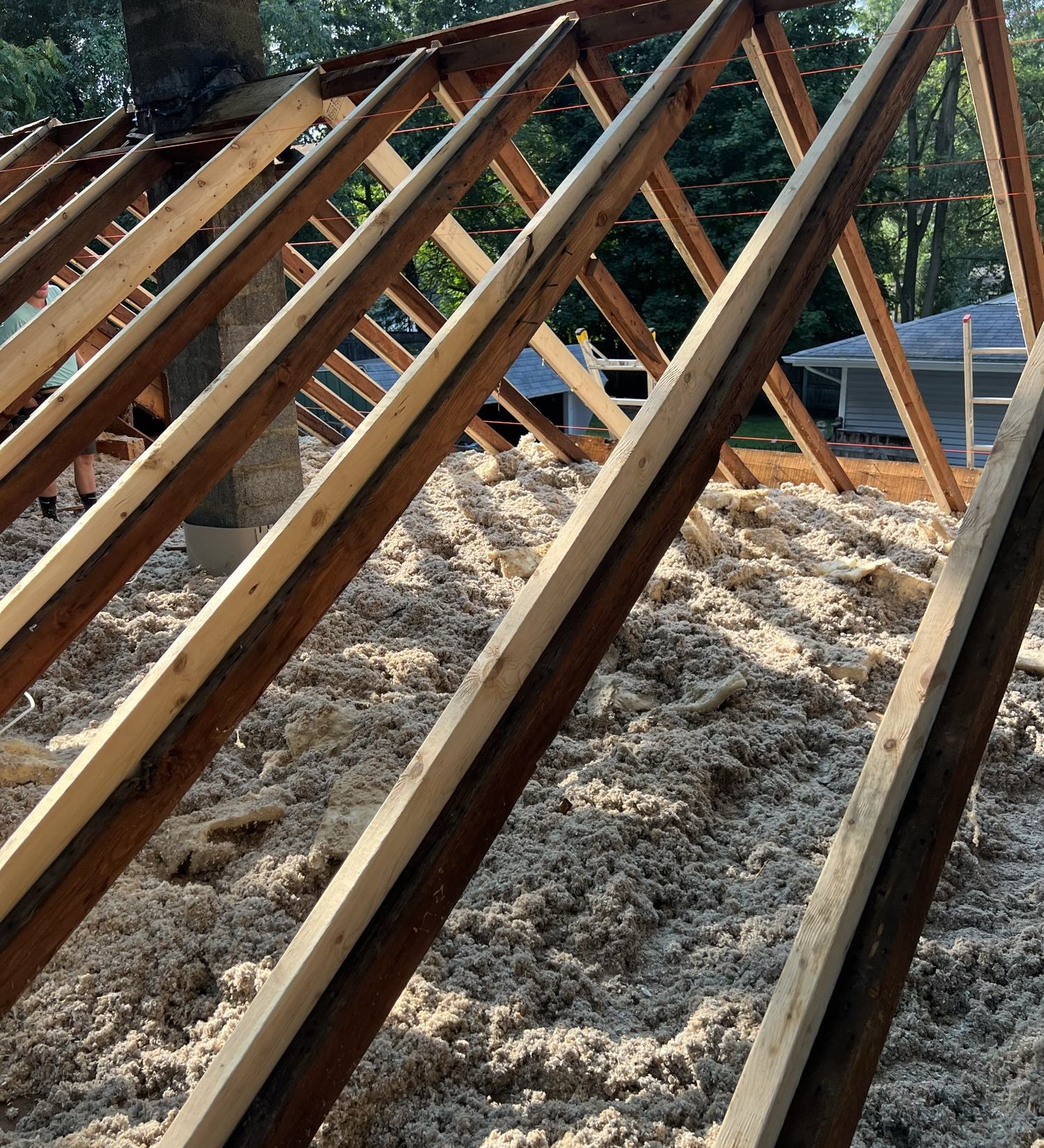
The good news: caught early, most deflection can be corrected with targeted structural repair. Sistering new rafters to the old ones, replacing decking, reinforcing framing. We've rebuilt entire roof sections over a kitchen and re-framed a whole roof under an engineer's spec, and both are in our gallery. The key is figuring out why it's bending, and doing it now.
What Causes Roof Deflection
It almost always traces back to one of these, and often several stacked up over years.
Undersized or Compromised Framing
Original 2x4 rafters that were never sized for the span, cut or notched trusses, a load-bearing wall someone removed in a remodel. The frame can't carry its load, and the ridge or rafters slowly bow.
Long-Term Water Damage
The most common cause we find. A slow leak, often from failed flashing or an ice dam, rots the rafters, trusses, or ridge board over years, softening the wood until it can't hold its shape.
Rotted or Delaminated Decking
Plywood or OSB sheathing absorbs moisture, swells, and comes apart in layers. Deflection between the rafters, a wavy or dished look across the roof plane, usually points to failing decking, not failing framing.
Snow and Ice Load
Lake-effect snow and ice dam weight put hundreds of pounds on a roof. One winter rarely deflects a sound roof. Twenty winters on an already-weakened structure will.
Age and Material Fatigue
Decades of expansion, contraction, and moisture cycling fatigue older roofs. On homes 30 or more years old, deflection often means the whole system is reaching the end.
Too Many Layers or Bad Original Construction
A roof built with too few fasteners, wrong-spec lumber, or two layers of shingles stacked on top is carrying more weight than it was designed for. That shows up years later as a bend.
How to Spot Roof Deflection
It can be obvious or subtle. Step across the street and sight down the ridgeline and the eaves. They should read as straight lines. Watch for:
- A dipping, curved, or bowed ridgeline
- A wavy or rippled look across a roof plane
- Rafters or decking visibly bowing in the attic
- Cracks in interior drywall, especially above door frames
- Doors or windows that suddenly stick or won't latch
- Gaps opening at the top of interior walls or at trim
- Water stains, damp sheathing, or mold in the attic
- Shingles that pull or dip in one area
- Any of these is a reason for someone to look at the structure, not just the shingles.
Why Deflection Is Common in West Michigan
Our climate is hard on roof structures specifically. Grand Rapids, Holland, Grand Haven, and Rockford sit in the lake-effect snow belt, where one system can drop feet of heavy, wet snow. When it melts and refreezes it forms ice dams that trap standing water at the eaves, one of the fastest ways to rot decking and rafter tails from the inside out.
Add constant freeze-thaw, humid summers, and the moisture that builds in a poorly vented attic, and you get slow structural fatigue. Older homes across West Michigan, many built before modern truss engineering and ventilation standards, are especially prone. We've seen roofs framed on 2x4s that carried the load fine for fifty years and then didn't.
Because these forces work slowly and out of sight, a roof can look fine from the curb for years while the decking softens underneath. Treat any dip in the roofline as a reason to look closer, not a reason to wait for spring.
What to Do About Roof Deflection
This is not a wait-and-see problem.
- Don't go up on it. A deflected area may already be unsound. Stay off the roof and out from directly under it.
- Get it inspected. We determine whether the cause is framing, decking, water, or load, and how far it's gone.
- Act on the findings. Caught early, targeted structural repair reinforces the frame. Advanced damage may call for a section rebuild or replacement.
- Get the snow off. If you're heading into winter with a weakened structure, roof snow removal reduces the load while you plan the fix. We do that too.
We're a licensed Michigan builder, not just a roofing contractor. That matters here more than anywhere else on the site. When the problem is the frame, we can assess it and rebuild it. Not just the shingles on top.
Seeing a Dip in Your Roofline? Don't Wait.
Deflection only gets worse, and more expensive, with every storm and every snowfall. Stellar Roofing Company will inspect the structure, tell you what's causing it, and lay out your options.
Roofline Deflection Questions
Is a sagging roof an emergency?
A minor, slow-developing dip usually isn't an immediate emergency, but it should be inspected promptly. A sudden or worsening dip, cracking or popping sounds, or deflection paired with active leaks can signal a structure that's failing now. In those cases keep people out from under the area and call right away.
Can a deflected roof be repaired, or does it need replacement?
Depends on the cause and how far it's gone. Caught early, it can often be corrected by sistering new rafters to the old ones, replacing rotted decking, or adding support. Widespread rot, failed trusses, or long-term water damage may call for a section rebuild or a full replacement. An inspection is the only way to know.
How much does it cost to fix?
It varies with the cause and the scope. Reinforcing a small section of framing is a moderate repair. Replacing rotted decking across a roof or rebuilding failed structure is a major one, and if it's tied to a covered event it may be an insurance claim. The first step is the inspection. From there you get an itemized estimate so there are no surprises.
Can heavy snow cause a roof to sag?
Yes. Lake-effect snow and ice dam loads put hundreds of pounds on a roof. One winter rarely deflects a sound roof, but repeated heavy loads over years, especially on an already-weakened or aging structure, can cause permanent bend. On roofs that are prone to it, seasonal snow removal helps.
Why is the roof dipping between the rafters?
A wavy or dished look between the rafters usually points to failing decking rather than the framing. Moisture makes plywood or OSB swell, delaminate, and lose stiffness, so it dips between its supports. That typically means replacing the affected decking during a repair or a re-roof.
How long can I wait before fixing it?
You shouldn't. Deflection accelerates as weight shifts onto the remaining structure, and West Michigan snow, ice, and moisture speed it up. Delaying turns a localized structural repair into a much larger one. Get it inspected as soon as you notice it.