
Roofing Materials • West Michigan
Metal Roofing in West Michigan
A metal roof can be the last roof you ever put on your home, shedding lake-effect snow, resisting ice dams, and lasting two to three times longer than asphalt.
But "metal roof" isn't one thing, and the difference between the systems matters more than the metal. Here's an honest look at standing seam, metal shingle, and exposed-fastener panels: how each actually performs through Grand Rapids and lakeshore winters, what they really cost, and the truth behind the noise myth.
Is Metal Roofing Right for a Michigan Home?
For decades, metal roofing in West Michigan meant a pole barn or a farm outbuilding. That's changed. Homeowners from Grand Rapids to Holland to the Lake Michigan shoreline are choosing metal for the same reasons those barns lasted 50 years: it sheds snow, shrugs off weather, and asks almost nothing of you.
Our climate is exactly where metal earns its keep. Heavy lake-effect snow, relentless freeze-thaw cycles, and the ice dams that form at cold eaves are the biggest enemies of a West Michigan roof, and a well-designed metal system attacks all three. Snow slides off before it loads the structure, water can't creep under interlocking seams, and the smooth surface gives ice far less to grab.
Metal isn't the cheapest roof, and not every metal roof is the same roof. Below we break down the systems, explain why they age completely differently, and lay out the real trade-offs, so you can decide with clear eyes.
Not All Metal Roofs Are the Same
Two roofs can both be "metal" and be completely different systems, with completely different long-term performance. The difference isn't the panel. It's how the panel is attached, and that one decision drives everything: lifespan, maintenance, and where the leaks eventually come from.
Concealed fasteners, floating panels
Standing Seam
Starts around $12 per square foot installed, can exceed $25 to $30 — Lifespan: 40 to 70 years
The premium system, and the one we almost always recommend on a house. Vertical panels interlock at raised seams, and every fastener is a concealed clip hidden inside the seam, where weather can never touch it. Nothing penetrates the panel surface. Just as important, the clips let the panels float: metal moves with every temperature swing, and on a standing seam roof that movement is designed in instead of fought. We install snap-lock standing seam in 24-gauge steel with a Kynar 500 finish, panels from Metal Sales and Central States, and we design snow retention into every one.
Concealed fasteners, traditional look
Metal Shingles and Shakes
Priced on inspection — Lifespan: 40 to 60 years
Stamped steel or aluminum made to mimic dimensional shingles, slate, or shake, with the fasteners concealed like standing seam. A fit for homeowners who want metal's durability without changing the look of the neighborhood. Costs vary widely by profile and manufacturer, so we quote it after we've seen the roof.
Screws through the panel face
Exposed-Fastener Panel
Priced on inspection — Lifespan: 25 to 45 years, with maintenance doing the deciding
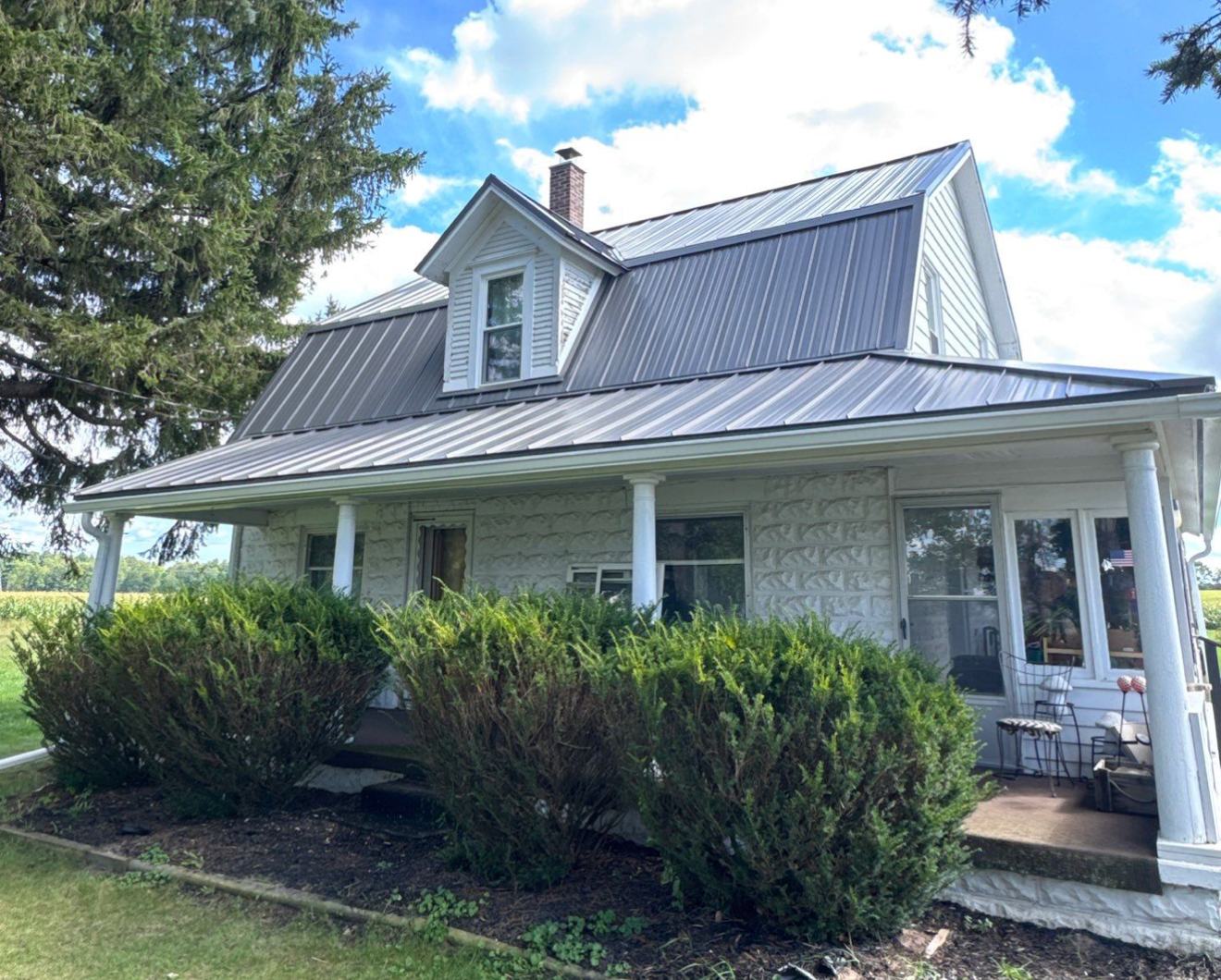
Ribbed or corrugated steel screwed directly through the panel into the structure, the classic barn roof, and the budget metal option. Right for pole barns, outbuildings, garages, and agricultural buildings, and increasingly requested on modern-farmhouse homes. On a house, we'll install it if that's the budget, and we'll tell you exactly what you're signing up for, which is the next section.
Why Standing Seam Outlasts Exposed Fastener
Here's the education most roofing companies skip, because it takes longer than "metal lasts 50 years."
An exposed-fastener roof is attached with screws through the face of the panel, roughly 60 to 80 of them per 100 square feet. On a typical house, that's well over a thousand penetrations through the very surface that's supposed to keep water out. Each one is sealed by a small rubber washer, and those washers live a hard life: baked by UV in summer, frozen in winter, compressed and flexed through every one of our freeze-thaw swings. They dry out, crack, and fail, usually starting somewhere in years 10 to 20, decades before the steel itself is done.
It gets worse, because the panels can't move. Metal expands and contracts with every temperature change, and an exposed-fastener panel is pinned rigid by its own screws. That force has to go somewhere, so it goes into the screw holes: washers fatigue, holes elongate, screws back out, and water finds the gap. An exposed-fastener roof isn't a bad roof. It's a roof with a maintenance schedule, and the honest ownership picture includes periodic fastener checks and, eventually, re-gasketing or re-screwing.
A standing seam roof exists to solve exactly those two problems. The fasteners are concealed clips inside the seam, so there are zero penetrations through the panel surface and no washers exposed to weather. And the clips let the panels float, so fifty years of expansion and contraction stress nothing. That's why standing seam runs 40 to 70 years with very little attention while exposed fastener needs real fastener maintenance at 20 to 30. Same metal. Two completely different machines. It's also why standing seam costs more: thicker 24-gauge panels, more fabrication, and a crew that knows the system, versus thinner 26-to-29-gauge panels screwed down fast.
When you compare metal bids, this is the first question to ask: where are the fasteners? If one bid is dramatically cheaper, this is usually why.
Metal vs. Asphalt Shingles
Asphalt is still the right call for many West Michigan homes. Here's how the two stack up so you can weigh up-front cost against lifetime value.
| Feature | Metal Roofing | Asphalt Shingles |
|---|---|---|
| Installed cost | Standing seam starts around $12 per sq ft, exposed fastener less, priced on inspection | $5 to $10+ per sq ft |
| Lifespan | 40 to 70 years (standing seam) | 20 to 30 years rated |
| Snow shedding | Excellent, sheds naturally | Fair, snow sits and builds |
| Ice dam resistance | High with proper design and a ventilated attic | Moderate, relies on ice and water shield and ventilation |
| Weight | Light, roughly 1 to 1.5 lb per sq ft | Heavier, roughly 2.5 to 4 lb per sq ft |
| Fire rating | Class A, non-combustible | Class A on most products |
| Maintenance | Very low (standing seam) | Periodic repairs |
| Recyclable | Yes, fully, at end of life | Rarely, most ends up in a landfill |
The takeaway: asphalt wins on up-front cost, metal wins on longevity and winter performance. If you plan to stay long term, or you want to buy a roof once and be done, standing seam often costs less per year of service. Compare full pricing on our metal roof cost page.
Why West Michigan Homeowners Choose Metal
The reasons metal makes sense here all trace back to one thing: our winters.
Built for Lake-Effect Snow
West Michigan winters dump heavy, wet lake-effect snow. Slick panels let it slide off before it builds into the kind of load that stresses framing or feeds ice dams at the eaves. And because a sheet of sliding wet snow weighs hundreds of pounds, we design snow retention, guards or rail clamped to the seams, into every metal roof we install, sized to the pitch and panel length. If nobody designs for it, the gutters come off every winter. We've seen it on roofs designed by architects.
40 to 70 Year Lifespan
A quality standing seam roof can be the last roof you ever buy. Where asphalt gives you 20 to 30 years, standing seam routinely doubles or triples that with almost no upkeep.
Fewer Ice Dam Headaches
Snow sheds instead of piling, so properly designed metal roofs are far less prone to the ice dams that plague homes here every January and February. One honest caveat: ice dams start in the attic, and a metal roof over a badly vented attic still ices at the eaves. We fix the attic on every metal job.
Energy and Reflectivity
Reflective and cool-metal finishes bounce summer heat away, easing attic temperatures and cooling loads through humid Grand Rapids summers.
Wind and Fire Resistance
Interlocking panels locked to each other, not just nailed to the deck, carry superior wind resistance and a Class A fire rating, and many of the panels we install carry a UL 2218 Class 4 impact rating, the highest hail rating there is, which some insurance carriers discount premiums for.
Lightweight and Recyclable
Metal weighs a fraction of asphalt, so it's gentler on the structure, and it's fully recyclable at end of life instead of landing in a fill.
Is a Metal Roof Loud in the Rain?
It's the number-one question we hear, and the answer surprises people: a modern residential metal roof is no louder than asphalt. The "rain on a tin roof" sound comes from bare panels over an open barn with nothing underneath. On a house, the metal sits over solid decking, underlayment, and an insulated attic, and those layers absorb the sound before it reaches your living space.
While we're at it:
- "Metal attracts lightning." It doesn't, and because it's non-combustible, it's actually safer if lightning ever does strike.
- "It rusts." Modern steel is galvanized and factory-coated. Our standard Kynar 500 finish is the premium coating in the industry, and quality finishes carry decades-long warranties against corrosion and fading.
- "It makes the house hot." Reflective finishes do the opposite: they bounce summer heat away and can lower cooling costs.
- "Metal is maintenance-free." Very low, yes. Free, no. Pipe boots are still neoprene, counter flashing still relies on sealant, and there is no totally maintenance-free roof. A properly designed metal roof stretches that maintenance out as far as it can go, and the stretch is designed in.
The Honest Trade-Offs
We'd rather you go in with your eyes open. Metal is a fantastic roof, but it isn't the right answer for every budget or every home:
- Three to five times the up-front cost of asphalt for standing seam, though often a lower lifetime cost
- Requires a crew trained in the system; a crew that's great with shingles can still get the expansion, flashing, or seam detail wrong, and those mistakes show up as leaks a few winters later that nobody can find
- Panels can dent from very large hail or heavy falling limbs
- Sliding snow must be designed for, which is why snow retention is part of every metal roof we build
- Color and profile choices are narrower than shingle lines
- Future repairs need a roofer who actually works in metal, and panels must be color-matched
Not sure metal is the right fit? A targeted roof repair or a new asphalt replacement may serve you better. We install both with our own trained people, which is exactly why the recommendation you get is about your roof, not our sales sheet.
Thinking About a Metal Roof?
A metal roof is a lifetime investment, and it can be spread into affordable monthly payments through multiple lenders. Stellar Roofing Company designs and installs standing seam, metal shingle, and exposed-fastener systems across Grand Rapids, Holland, Ada, and the lakeshore, and every metal quote starts with an inspection that counts every edge and penetration, because that's where the number really comes from.
See Metal Roof InstallationExplore Metal Roofing & More
Metal Roof Replacement
Our full standing seam and metal roof installation service.
Learn MoreMetal Roof Cost
Detailed pricing for metal systems in West Michigan.
Learn MoreRoofing Materials
Compare metal, asphalt, and every option for our climate.
Learn MoreRoof Financing
Spread the cost of a lifetime roof into monthly payments.
Learn MoreMetal Roofing Questions
How long does a metal roof last in Michigan?
It depends entirely on the system. Standing seam, with concealed fasteners and floating panels, runs 40 to 70 years and is often the last roof a home needs. Metal shingles typically run 40 to 60. Exposed-fastener panels are rated 25 to 45 years, but the honest number depends on maintenance, because the rubber washers sealing every screw start failing at 10 to 20 years and need attention long before the steel is done. That's two to three different ownership experiences from the same word, "metal."
What's the difference between standing seam and exposed fastener metal roofs?
Everything that matters. Exposed-fastener roofs are screwed through the panel face, over a thousand sealed penetrations on a typical house, and the panels are pinned rigid, so thermal movement works the screws loose and wears out the washers over time. Standing seam hides every fastener inside the seam on floating clips: zero surface penetrations, and the panels expand and contract freely for decades. That one difference is why standing seam lasts 40 to 70 years with very little maintenance while exposed fastener needs periodic fastener work, and it's why standing seam is what we almost always recommend on a house.
Are metal roofs good for snow?
Yes, snow performance is metal's biggest advantage here. Slick panels let heavy lake-effect snow slide off before it builds into a load that stresses the structure or feeds ice dams at the eaves. Because that snow comes off in heavy sheets, we design snow retention into every metal roof we install, over doors, walkways, gutters, and anything below. And since ice dams start in the attic, we fix the ventilation on every metal job too.
Are metal roofs noisy when it rains?
No. A modern residential metal roof is no louder than asphalt. The tin-roof sound comes from bare panels over an open barn. On a house, the metal sits over solid decking, underlayment, and an insulated attic, which absorb the sound before it reaches your living space.
How much does a metal roof cost in West Michigan?
Standing seam starts around $12 per square foot installed and can exceed $25 to $30 on complex roofs, versus $5 to $10-plus for architectural asphalt. Most of that range is the accessory work: every edge, valley, hip, and penetration is a hand-fabricated detail, and the crew moves five to ten times slower than shingles. Metal shingles and exposed-fastener panels cost less and are priced on inspection, because profile and roof complexity swing the number too much for a flat range. See our metal roof cost page for the full breakdown, and ask about financing.
Will a metal roof attract lightning or rust?
Neither. Metal doesn't attract lightning, and because it's non-combustible it's actually safer if lightning strikes nearby. Modern steel panels are galvanized and factory-coated, and our standard Kynar 500 finish carries a decades-long warranty against corrosion and fading. Aluminum won't rust at all.
Can you put a metal roof over existing shingles?
Sometimes, but we usually recommend a full tear-off. Installing over old shingles can trap moisture and hide deck rot from past leaks or ice dams, and Michigan Residential Code Section R908.3.1.1 caps a roof at two layers. A tear-off lets us inspect and repair the deck, install ice and water shield, correct the ventilation, and give a lifetime roof the clean, warrantied start it deserves.